Jamming challenge
Zhulynsky served in the Ukrainian army as a mortarman, where he deeply understood the needs of soldiers on the front lines. He was fascinated by the Mavic quadcopters that the team used to search for targets and fire at a target. In the summer of 2022, the car Zhulynsky was driving hit a mine, killing two members of his team and seriously injuring himself.
Due to his injuries, Zhulynsky was unable to return to active duty, but he still wanted to help in the war effort. FPV kamikaze drones were starting to gain popularity, and Zhulynsky, along with some colleagues, founded 3DTech to manufacture drones. The company partnered with Ukrainian technology incubator BRAVE1, and by the summer of 2023, they were supplying the Ukrainian armed forces with FPVs called “Khizaki.” Unlike some of their Russian counterparts, 3DTech was constantly improving and adjusting its design in response to feedback from the front.
“Every month, new methods and technologies emerge, and we need to keep up with them,” says Zhulynsky. “We are actively seeking, testing, and implementing new technologies because modern warfare is evolving very quickly.”
Jamming, as always, remained a problem as both sides filled their front lines with portable electronic warfare equipment to disrupt drone communications. It quickly became a serious problem. In March, General Schill, the French army’s chief of staff, said that jammers had disabled 75 percent of drones in Ukraine, and he expects that number to rise.
“Soldiers reported that there was a very high concentration of electronic warfare (EW) systems in some areas of the front, especially where important enemy targets were located,” says Zhulynsky. “Many valuable targets were completely out of reach because of these powerful EW systems.”
Ukrainian (and Russian) developers have used various methods to make their drones more resistant to jamming. But every step is met with counter-steps from jamming developers, and constant updates are needed just to keep the drones flying. The ideal solution would be one that could defeat any jammer.
“We turned our attention to the only communication channel that can be used in such conditions — fiber-optic communication,” says Zhulynsky.
Fishing for cyclists
Zhulynsky says that some developers experimented with fiber optics early in the war, but there was little interest in it at the time, since radio communications were still working well. When the front was saturated with jamming installations, 3DTech turned its attention to the technology again.
One of the biggest problems was the cable, which, like other types of glass, is strong but fragile.
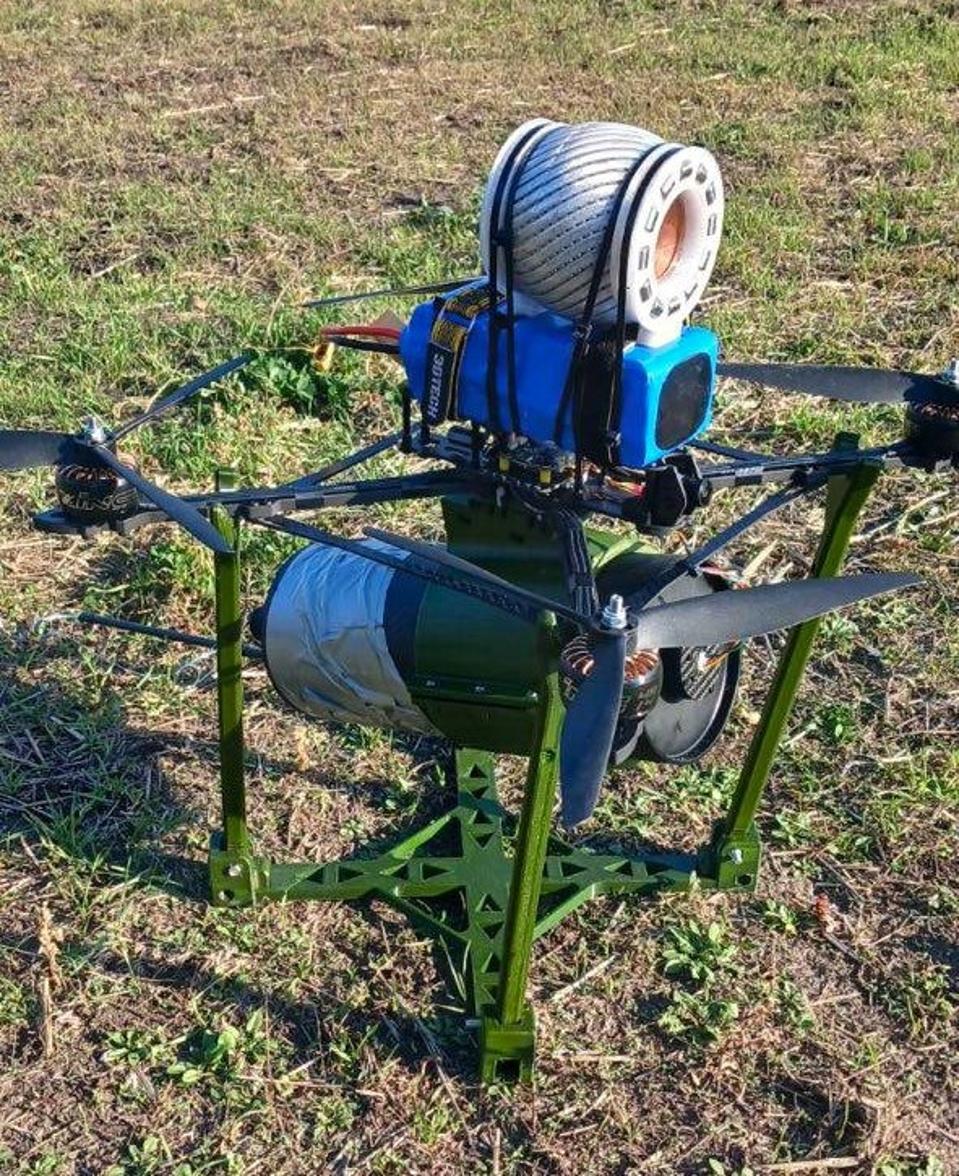
“We encountered problems during the transportation and use of drones, as fiber optic cables can easily break or break. This prompted us to create specialized systems to evenly wind and unwind the cable during flight, to prevent sagging and tangling.”
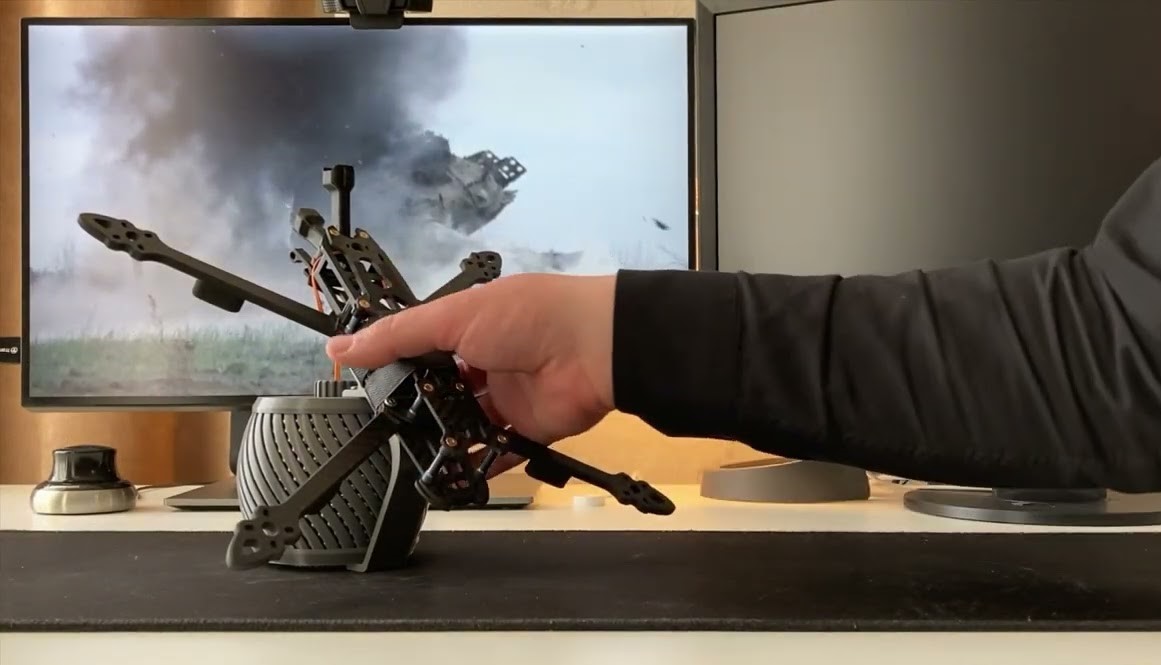
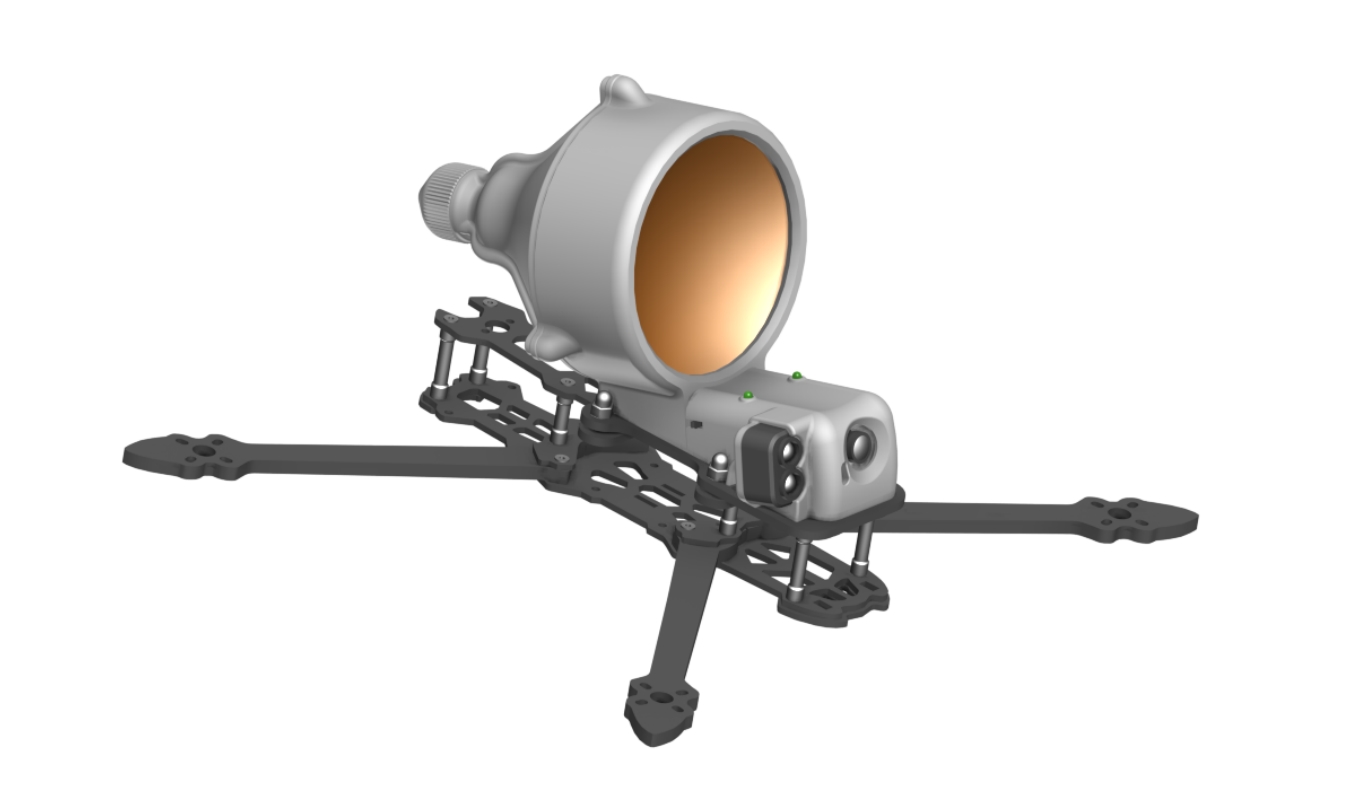
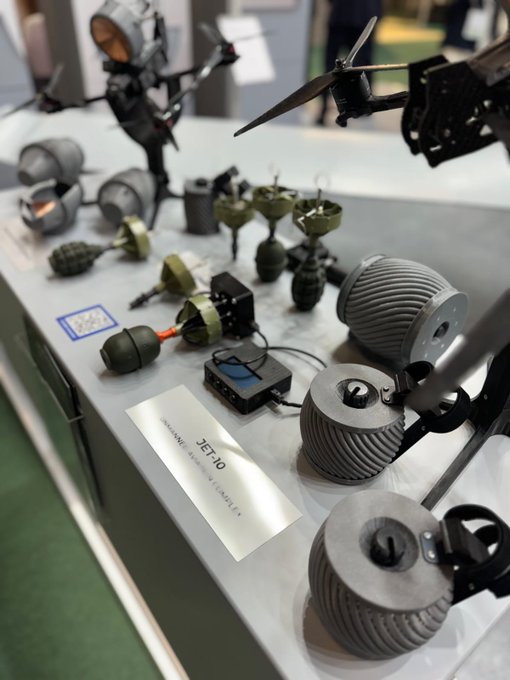
Attaching the reel to the drone posed some difficulties, given the need to avoid contact with the drone’s propellers and prevent it from snagging on obstacles.
The fiber optic cable could be surprisingly strong. Zhulynsky recounts an incident during the first test flight. A group of cyclists crossed the path of the drone; Zhulynsky, while piloting the drone, misjudged the distance. The next time he felt someone tug on the cable, like a fish on a fishing line. The line caught one of the cyclists and knocked him off his bike.
“The cable didn’t break, which proves its strength, but we had to apologize profusely because the cyclist was unhappy with the situation,” Zhulynsky says.
The early test version had only 1 kilometer [0.6 miles] of rope, but it proved that the technology worked.
“We were impressed with the speed of data transfer and the lack of interference,” says Zhulynsky. “The only problem was the weight of the coil. Later, we assembled working versions of the drone with a 5-kilometer [3.1-mile] coil and took them to the front lines to get feedback from our service members. They were very impressed with the product and provided several recommendations for improvements, which we began implementing.”
Problems and opportunities of piloting
The cables unwind as the drone moves, so there’s no tension (unless a cyclist runs over them). But while the cable has good tensile strength, there are piloting issues: it’s brittle if you bend it more than 45 degrees, or it gets tangled.
“Pilots really need to be more careful,” says Zhulynsky. “While our reel mounting system minimizes the risk of cutting the cable, pilots still need to be mindful of the fiber optic cable behind them and avoid sharp or quick maneuvers that could cause the propellers to cut the cable.”
There’s also the added weight. The reel weighs 300 grams, and 5 kilometers of cable weighs 1.25 kilograms, so a system with a flight range of 10 kilometers carries an additional 2.8 kilograms, which significantly reduces the available payload. That’s why Zhulinsky says larger drones were used for longer ranges. A 13-inch drone can carry enough cable for 10 kilometers, as well as a 2-kilogram/4.4-pound warhead. Longer ranges would be possible with larger drones like the Queen Hornet.
Fiber-optic control also opens up new possibilities. Since radio control relies on line-of-sight, FPV modules must remain high to maintain contact before the final dive.
“Some areas of the front line have complex terrain, including elevation changes, valleys, and forests, which makes it difficult to use radio-controlled drones. Fiber-optic drones completely eliminate these problems,” Zhulinsky says.
As Russian vandals have already shown, fiber-optic drones can fly at extremely low altitudes—as low as knee-high—and appear at unexpected angles.
“The enemy often expects the drone to attack from above, so they tend to watch the sky. However, fiber-optic drones can approach targets out of the enemy’s line of sight, flying at low altitudes, which increases their effectiveness and adds an element of surprise.”
Urban fiber optic warriors
The limited line-of-sight means that most drones lose connection when they are inside a building more than a few feet away.
“Optical guidance provides a stable connection even in closed spaces where conventional radio signals can be blocked by walls or barriers,” says Zhulynsky.
Working in tight spaces without damaging the cable requires a complex unwinding mechanism to prevent it from tangling.
“After improving the mounting system for the fiber-optic coil, we achieved very high maneuverability of the drones. They can hover, turn in place, and navigate around both small and large objects at low and high speeds,” says Zhulynsky. “This maneuverability allows the drone to easily explore every room in a building or access more difficult shelters.”
The Russian Vandal drones have already shown how they can hit targets inside buildings, and the REBOFF can fly much deeper.
This opens up the possibility of drones for urban or underground combat, moving ahead of or even replacing infantry, inspecting buildings and attacking targets while their operators remain at a safe distance. (Israeli company XTEND is developing a similar approach, using fiber-optic cables for its drones. Others are likely to follow suit.)
Fiber-optic drones in action
REBOFF has successfully completed military testing, and 3DTech is preparing the first batch for delivery. They are likely to be deployed immediately after delivery.
Meanwhile, the drones are undergoing certification so they can be purchased through the standard military procurement process. Zhulynsky says that with the resources available, they can produce a thousand RedOFFs “in a relatively short period of time.” After that, it all depends on demand growth.
Meanwhile, a number of other Ukrainian developers are working on fiber-optic drones, and the German company HIGHCAT has demonstrated its technology to Ukraine. The technology is inexpensive, and while there are technical difficulties, it is likely to spread quickly.
3DTech is already considering improvements for the next generation. Among them are thinner and lighter fiber-optic cables, which provide greater flight range or payload. They also plan to integrate the terminal guidance system with artificial intelligence to increase hit rates and reduce the need for a trained pilot. Fiber optics means that the expensive AI unit can be housed in the operator’s control unit, rather than being lost with the drone.
Other developments include combinations of radio and fiber optics for operational flexibility, as well as the introduction of fiber optics for drone motherships. These are drone carriers that will be able to expand battlefield operations by delivering FPV-insensitive drones behind enemy lines.
Zhulynsky says the same technology could be applied to ground robots and remotely controlled weapons such as the Death Scythe. Fiber optics are likely to be invaluable wherever high-intensity jamming makes radio-controlled drones ineffective.
“Fiber-optically guided unmanned aerial vehicles are an innovative and promising technology that can solve tasks that go beyond the capabilities of traditional drones. Our goal is to make this technology as accessible and effective as possible to help our military,” says Zhulynsky. “But this project is not just about technology; it is aimed at making a real contribution to the safety and effectiveness of our military on the front lines.”